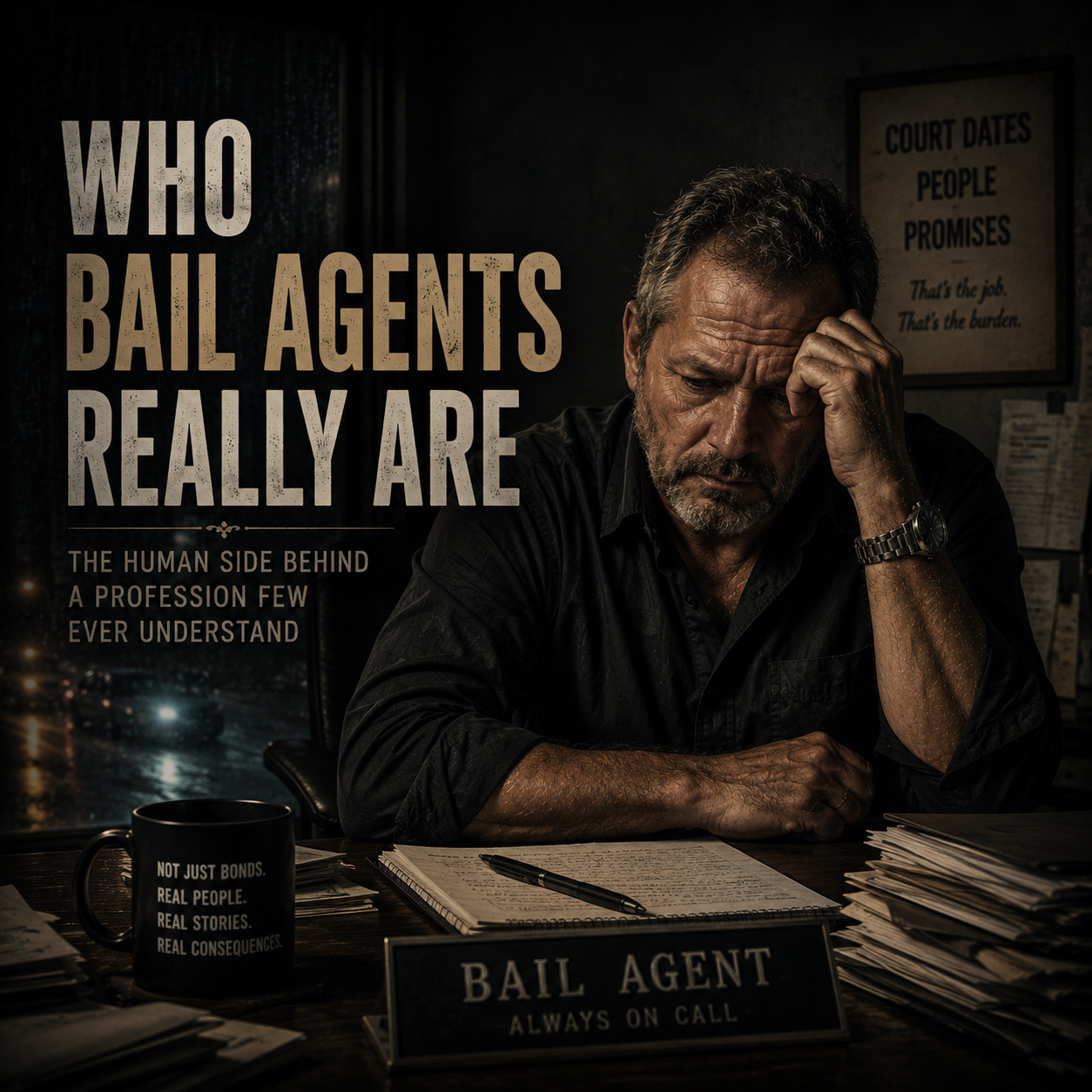
Who Bail Agents Really Are: The Human Reality Behind the Stereotypes
Behind every late-night phone call is a bail agent carrying the emotional weight of other people’s crises. This is a profession built on endurance, judgment, compassion, and accountability — far beyond the stereotypes most people have been taught to believe.
“What decades of answering the phone in the middle of the night reveal about the people who do this work.”
Can we have a serious conversation about bail agents — not the version you see on television, not the political stereotype, but the actual people who do this work?
Most individuals only cross paths with a bail agent during one of the most disorienting and frightening chapters of their lives. The phone rings late at night or in the earliest hours of the morning. A mother’s voice trembles as she explains that her son has been arrested. A spouse fights back tears while trying to understand how much it will cost and what happens next. In those moments, the bail agent becomes more than a business transaction. They step into someone else’s crisis and shoulder part of the weight.
What the public rarely understands is that the people answering those calls have often been doing so for ten, twenty, or thirty years. This is not a temporary job for them. It is a vocation that demands a particular combination of practical intelligence, emotional steadiness, and quiet endurance.
Experienced bail agents develop an almost visceral understanding of human nature under extreme pressure. They learn to listen not only to the words being spoken but to what is left unsaid — the hesitation in a voice, the exhaustion behind forced optimism, the difference between genuine remorse and calculated manipulation. Over time, they become remarkably skilled at reading situations and people. Many describe developing an intuition that allows them to assess risk not merely through paperwork and criminal history, but through subtle cues gathered during late-night conversations and difficult home visits.
The work is relentless in its emotional demands. Bail agents routinely comfort frightened parents who feel they have failed their child. They sit with families unraveling under the strain of addiction. They guide young people who have made life-altering mistakes through the immediate aftermath of their decisions. Some agents quietly drive defendants to court when no one else will, check on them during difficult periods, or offer steady advice that goes far beyond the requirements of any indemnity agreement. In many cases, they become temporary counselors, mediators, and one of the few stable presences in lives marked by chaos.
This constant exposure to human suffering leaves a mark. Many veteran agents carry an accumulated emotional burden that few outside the profession ever see. They remember the cases that ended well — the person who got clean, showed up for every court date, and slowly rebuilt their life. They also carry the heavier memories: the ones who relapsed, the families that fractured beyond repair, the young faces that never quite made it back from the edge. Sleep can be inconsistent. The phone can ring at any hour. Holidays and family events are often interrupted. Yet they continue answering because that is what the work requires.
There is a particular mindset that seems common among those who stay in this profession for the long term. It is a blend of realism and compassion. They tend to believe deeply in second chances while understanding that not everyone will take them. They develop genuine respect for human resilience while maintaining a clear-eyed awareness of how fragile that resilience can be. Many speak of a sense of purpose that emerges after years in the field — the quiet satisfaction that comes from helping a family navigate an impossible moment or seeing someone make it to court when the odds were stacked against them.
These are not one-dimensional figures motivated solely by financial gain. The best bail agents bring considerable intelligence and practical wisdom to their work. They master complex areas of court procedure, forfeiture regulations, risk evaluation, and human psychology. Many become deeply knowledgeable about addiction, mental health, and the intricate ways families fracture and sometimes heal. They do this while managing significant financial risk on a daily basis, often while juggling the administrative and emotional demands of running their own businesses.
What stands out most, though, is their dedication. They show up consistently in an environment where crisis has no schedule and gratitude is often in short supply. They absorb stories of pain, poor decisions, and quiet desperation that most people prefer to keep at a distance. They do so with the understanding that their role, while essential, will rarely be celebrated or even fully understood by the broader public.
The profession has its imperfections, as every human endeavor does. But at its heart, it is populated by people who have chosen to stand in one of the more difficult intersections of American life — where law, family, failure, and hope collide. They are the ones answering the phone when the rest of the world is asleep. They are the ones willing to extend measured trust when others have withdrawn it. They are the ones carrying the unseen emotional weight of thousands of human stories.
These are the bail agents I know. Dedicated, resilient, emotionally intelligent individuals who have committed their lives to working inside realities most people only encounter briefly in their own moment of need. Their story deserves to be told with more depth and honesty than the caricatures usually allow.
Author Bio: Mike Morrison is the 2026 PBUS National Bail Agent of the Year and current President of the Mississippi Bail Agents Association. With over 34 years of hands-on experience as a bail bond agent and owner of Mike Morrison Bail Bonding Company in Hattiesburg, Mississippi, he has become a leading advocate for the commercial surety bail industry. A prolific writer on Medium, Morrison regularly defends the traditional surety bail system, emphasizing public safety, personal responsibility, court accountability, and constitutional pretrial rights. His perspective is grounded in daily frontline experience rather than academic theory.